

Cider Freaks
Craig Cavallo on wild apples, cultural terroir, and why cider makers never make the same thing twice
I discovered Golden Russet soon after moving to Kingston. It’s the ideal country diner/grocery/general store: hand-painted sign over the door, fridges with homemade soups and pasta salads, some select grocery items like ramen or flour or ketchup to save you in a pinch, a tight daily menu of egg sandwiches, burgers, tuna salad, grilled cheese, coffee that you serve yourself, and perfect griddled banana bread sprinkled with flaky salt. If it’s winter, you want to squirrel yourself away into a booth and listen to the hiss of the grill and clink of spoons, and if it’s summer you want to sit at a table in front to watch the birds and the occasional car that rolls by.
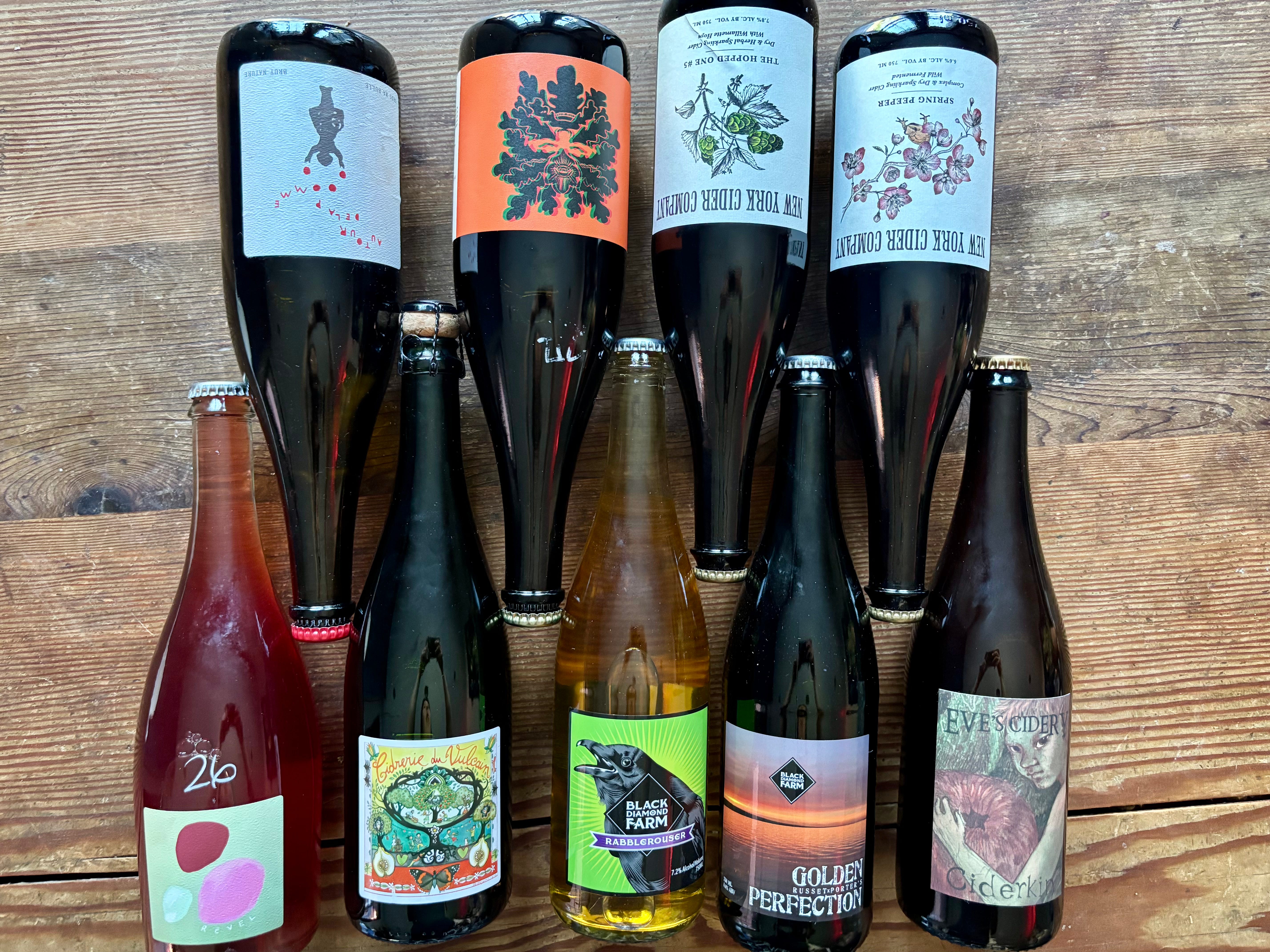
After pregnancy, I started buying cider from the long back wall at Golden Russet stocked of artfully labeled bottles but didn’t think much about it at first; the Hudson Valley makes really nice cider. Soon I realized they had the best cider selection anywhere in the area, and as cider replaced wine in our weekend dinners, I was coming back and back and noticing new details with each bottle. Like wine, cider has way more complexity than the dichotomy of sweet versus dry that’s drilled into us by the sugary cans at the supermarket. I started to enjoy the funky barnyard-y flavors that seem to come with foraged fruit and the oakiness from ciders aged in wine barrels. “Golden Russet,” I learned, was a reference to the apple not the potato, and a single-varietal golden russet cider is one of the simplest most delicious ciders you can get.
I could write a whole book about the burgeoning cider industry in the U.S. but I don’t have to, because Golden Russet’s owner Craig Cavallo already has. American Cider is a fascinating and honestly slightly strange book — it starts so early in American history that we’re learning geology to understand fruit growing regions, and then traces colonization and the spread of apples across the landscape until we get to some of the most interesting cider makers of today.
Before we dive into this interview with Craig, we need to mention something about apples: the thing about apples is that they’re a totally weird fruit. The way you learned about trees growing in children’s books — where a seed from an apple pit travels on the wind and buries itself in the ground and grows up into another apple tree — is not how apples are grown in orchards. An apple from a seedling tree is so unpredictable and different from its parent that instead of rolling the dice, apple farmers always clone trees, by grafting (basically duct-taping) a small branch from a tree they like onto another tree’s rootstock, which then causes it to produce the same apples as the original (crazy, right?). Seedling and wild apples can still make tasty cider though, and that’s why foraging is such a big part of the recent cider movement.
Okay, let’s get into it with Craig!
Apples are common in all parts of the country — in the mountains of Arizona and down as far south as Arkansas, obviously up in the northwest. So in all the corners of the country, people have [a variety] that’s unique to them. Apples are like…the non-partisan pom. It’s a peaceful entity.
Matt Kaminsky in Massachusetts has been heading up this pomological seedling exchange, I think it’s the fifth or sixth annual one now, where he invites people to bring unknown fruit that they find. And the people who discover it can name it. It hearkens back to when there were pomological societies in every county and every state in our country. It’s a wonderful example of our generation championing unnamed things and it sort of embodies the ethos of cider.
In beer, there’s Pilsner and Lager and Kolch and Porter, and in wine, there’s Brunello and there’s champagne and there’s all these structured categories. But with cider, there’s no ceiling. It’s just completely wide open every year, and that’s what’s fun to me. I’m just randomly guessing, but maybe 75% of people making cider in our northeast region, they’re not making the same thing year after year. Every year the fruit they have access to varies, so with every release, it’s like, Let’s see what the cider maker learned. Let’s see what they’ve found, and let’s see how that speaks in the end product.
I think you could say that, if you’re drinking a bottle of cider, that product is a better expression of the cider maker’s personality. Like if you’re making Châteauneuf-du-Pape, and it’s the best wine ever, those grapes are being grown in the same way every year, to the best of the grower’s ability. The blends are the same percentage, and so generally you’re going to be getting the same thing. Whereas cider sort of celebrates the maker in a unique way.
K: Do you think that’s an artifact of cider being a nascent industry, or inherent to working with apples vs grapes?
Both. Cider is pretty nascent still. In Spain and France, in the UK, they have these generational cultures of making cider. But here, when we started growing apples commercially in the late 1880s, it was just to eat fresh fruit [versus growing apples specifically for cider]. So that’s what made it possible for people here to start making cider, but now there’s this whole contingent of people looking for seedling fruit and wild apples and foraging. There’s a momentum shifting, and a mindfulness of sustainability and how farming and agriculture can continue and what it’s gonna look like in pursuing years with the world kind of turning in on itself.
So cider is very much in this buzzy phase, there’s lots of good tension and excitement around it, and it allows for a willingness to explore. Right now the market is willing to sustain this creative curiosity from these weird anarchists that are out there digging through the woods and poison ivy and ticks to find the best tasting — or in some cases worst tasting — apple that’s gonna make the best cider. It’s nice that freaks can be supported.
K: Something I’m hearing from you is that cider-making is more reactive to the landscape, compared to how wine-making is a more controlled process and the product is more consistent.
The expectation is way different in cider. Part of what makes cider so limitless is that the genetics of apples are more diverse than they are in grapes, and there’s tens of thousands of apple varieties. There’s a big encyclopedic collection of, I think, fifteen or sixteen thousand named varieties in North America, but for every one named variety, there’s probably 30 unnamed varieties. It’s just completely wide open and diverse. And the varieties we have access to are going to be totally different in six years.
And then most cider makers are fermenting with ambient yeast — wild fermentation — where they press the juice into the fermentation container and then let it naturally ferment. A lot of times, without a controlled fermentation, you’re going to get weird notes. The result will be a bit more sprightly or funky or barnyard-y or pickle juicy. There’s a lot of different cellar techniques cider makers are using, but for the most part there’s a shared belief in wild fermentation.
K: What are some of the experiments or co-ferments you’re most excited about right now?
I’m still in my heart a purist, so I just like plain cider, but I also love living in a place where there’s such a bounty of other fruit, and that people are exploring the relationships there. There are a lot of cool co-ferments coming from the Finger Lakes [which is the Northeast’s biggest wine region]. If you can buy spent grapes from a winery and ferment your apple juice on it and extract this cool color and fun playful aromas, it just makes sense.
Then there’s Nika [Carlson], with Greenpoint Cidery, and she’s exploring Mulberry, Elderberry, Dandelion, and things like that. And Denny, he’s fairly new, he has Heartsby True Cider, and he’s also utilizing other fruits. Left Bank Cider up in Catskill does a really good job of using stone fruits with apples, you know, plum and peach with apple juice. It’s fun, and it’s a broader expression of our region and our terroir versus a singular fruit. I think one of the better expressions of foraged fruit is Packbasket, and that’s a label that South Hill’s Steve Selin makes — it’s wild fruit that he forages from the Finger Lakes National Forest, and it’s made like champagne.
I’ve tried to make the argument that people are part of the terroir, not just what’s in the ground. Culturally, the socioeconomics of a place and the people that comprise a place, the agricultural practices of the place [make up the terroir] not just the micronutrients and the biome of the earth.
New York cider is unique because apples have grown here longer. Like, compared to Washington [State], there’s two hundred extra years of growing fruit in the Northeast, and there’s no denying that apples grow very well here. So there’s a bit of subtle pride in that, in the fruit that’s grown here, as well as the seedlings that have shown up and like the climate here and are kind of saying, “Hey, this is what we can offer.”
K: I know it’s been a bad year for fruit trees, with the late frost that killed so many buds. How do you think the effects of climate change and unpredictable weather are affecting the cider industry, or what are people doing to try to future-proof it?
I think that’s the biggest impetus for why seedling varieties are becoming so vogue — because of their resilience. I got introduced to [an apple] consultant, Mike Biltonen, and the thing that keeps him up at night is, How can we how can we continue to grow fruit successfully in the face of climate change? And I say that because this orchard and all the orchards in our region were hit really hard by that freeze in April. That freeze killed everything. In our orchard, we went from having seven or eight hundred apples to probably fifteen. So some of the seedling fruits that are surviving now, it’s likely that they’re blooming at the end of April or even the beginning of May, because they genetically sort of like understand their environment, and if a tree doesn’t bloom until after the threat of the last frost, then the tree has a good chance of survival.
K: There are a lot of examples in the book of people taking over old orchards and starting to introduce new farming practices or who are out foraging wild apples. Are they all sharing ideas or fruit — does it feel like there is a philosophy of cider-making developing, or like a movement is happening?
There is a shared ethos for sure. People are considering sustainability a lot in cider making. There’s a conscious effort to do good and to be fair to the land you’re using to grow your fruit, and the people that are helping you grow your fruit. I also think the set of people consuming cider and making cider is a more diverse demographic than the beer or wine world [this seems to be supported by the limited data from the American Cider Association], and for whatever reason, people feel comfortable coming into the culture, it feels welcoming and not isolating. It's great to see how people can come into the community and make it their own, and help it grow and thrive and become better than it was before.