

On Being a Squirrel
A conversation with Ellena Baum about tree time and chestnuts
I wanted to send a reminder to order an Enchanted Forest Cookie Box! And if you’ve never tried a chestnut, this is your opportunity — you can now add one pound of fresh chestnuts from The Great Chestnut Experiment to your box, with pickups in Brooklyn on December 20th or Kingston on December 19th. Learn more about the box here or preorder now: https://buy.stripe.com/8x24gA4Pk4EH6qHg2Mco002
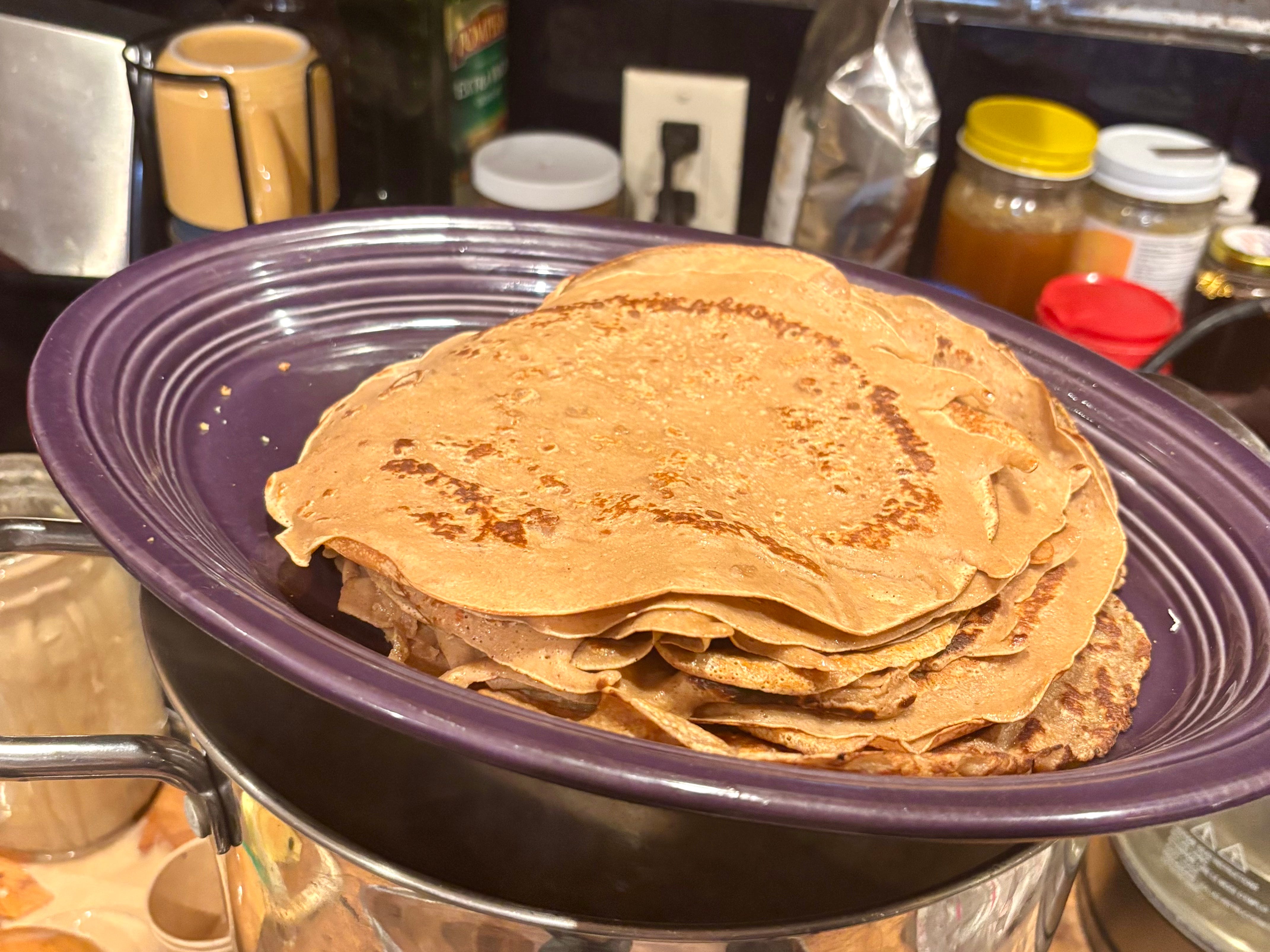
Last weekend I brought chestnut farinata and black walnut hot cocoa to the home of my new friend Mark who grows trees and processes acorns. It was cold and rainy so the planned chestnut roast was called off, but inside were huge bins of crabapples, which people were crushing in a manual grinder and then pressing into fresh cider. There was a 6-ft box full of acorns that somehow became a ball pit for three or four kids (including Miro), who shrieked when Mark poured more acorns on top of them. I tried acorn ice cream, acorn-chestnut shortbread, and a fresh shagbark hickory nut, which you’d swear was toasted or maybe even cooked in brown butter (and oops, it may be my favorite nut). I talked to people about nuts and mushrooms and trees and cooking and soaked up the general enthusiasm everyone seemed to have for the corner of the world they inhabited. It was a scene unlike anything I’d been part of before and made me feel more hopeful than I have in a while.
People seem to come into the tree crops world as a sort of calling. They were artists or activists or educators, and when they made the discovery that food could be grown in a way that builds ecosystems rather than destroys them, suddenly they knew what they wanted to do with their lives.
Ellena Baum, who organized the Big River Chestnut Festival I took part in in October, speaks about trees in this way — it was less of an “aha!” moment and more of a slow convergence of her practice of foraging wild foods and her work as a farmer growing vegetables. In her interview below, I love her musing, What if we could be like the squirrels? and help grow a forest that has things in it for us to eat. Now she’s the assistant manager of Big River Chestnuts in Massachusetts, which uses a system called alley crop agroforestry, or a biodiverse planting method that alternates rows of chestnuts with trees and shrubs like persimmon, pawpaws, and aronia, all grazed by sheep who control the weeds and fertilize the soil.
We started our conversation talking about her side project called Tree Time, which — forgive my oversimplification — sounds like the least-woo forest bathing experience that actually teaches you about trees. As Bug Nichols referenced in my last post about agroforestry, planting and working with trees necessarily changes your relationship to time. It’s so common these days to look into the future and see nothing but waste and catastrophe, but a tree that gives food to future generations is a glimmer of hope. Anyway, here’s Ellena on trees and chestnuts and being more like squirrels.
Tree Time evolved out of a desire to bring people together to teach basic tree ID skills, but in a space where we can really engage with the trees as our neighbors. When I bring students into the woods or when I lead tours at the chestnut farm, it’s to see the whole picture, to try to connect on multiple levels with multiple senses.
I called it Tree Time because trees exist on a timescale that’s not human. Human time and tree time are pretty interlinked, but having the opportunity to step into a time that exists on that scale — that’s so much longer than our lifespan and can bridge multiple generations of people — feels very important in this day and age.
I grew up in a city, New York City, with not as much daily access to trees. So it’s not something that I grew up doing since day zero. I farmed vegetables for many years and taught people about how to grow organic vegetables in a small scale farming context through community workshops. And then I felt that I moved away from vegetables toward trees…
Kate: And why was that?
Well, one version is, vegetables are a lot of work. Trees are less work.
But I don’t completely like that answer. [Editor’s Note: I do like that answer; I feel like it actually sums up a strong economic argument for why we should shift more of our farming towards agroforestry.] Another answer is that my last name is Baum, which means tree, and I feel like on some subliminal level I’ve been moving towards trees for a long time.
I’ve always been drawn to learning about trees as food in the wild sense, like looking for mushrooms in the woods, looking for acorns and hickory nuts. I remember the first time I went and harvested hickory nuts and made hickory milk. It wasn’t from cultivated trees — it may have been from a park which is a wild, a park that sort of bridges park-like characteristics and woods. And I was thinking, Humans can help this process, rather than just, like, go out and look for what already exists, like the acorns that are already falling in the woods. What if we did what the squirrels do, and contributed to this process for our own benefit?
So then I started making that connection between cultivating food and growing trees and having those two things be one and the same. I came upon agroforestry and started learning about how people have done it in the past and the possibilities for domesticating trees for food in an orchard setting.
Meanwhile, there were these extreme events that were happening to the land I as farming. There was increased flooding, and we had one year we couldn’t eat any vegetables after July 10th, because of this huge flood in the Connecticut River. I was already planting trees and encouraging different flood resistant plantings, but that flood emphasized a greater need to rely on more than just annual vegetables.
Kate: So why chestnuts?
Well, chestnuts are staple food in many parts of the world, and they were a dominant tree species in this country before the chestnut blight arrived in the early 1900s. They’re the starchiest nut — when we think of a staple food, we think of a food that can have many purposes and that’s nutritious, and that’s what a chestnut can do. They can be converted to flour, which is useful for a longer shelf life and another way to make it a multipurpose food. The American chestnut was a major food source here, though we have limited precolonial records of how it was used.
And why chestnuts is that it does exist as a global industry already. In this country we import six million pounds of chestnuts annually, so that shows you how much room there is to fill for fresh eating nuts. They’re culturally significant for so many people. The Chinese chestnut is smaller and sweeter, the European chestnut is bigger and less sweet, and there are other variations across the species, but enough similarities that people from different cultures can recognize something familiar to them.
Yellowbud Farm got a grant a couple of years ago with Route 9 Cooperative in Ohio to study different chestnut cultivars and how they affected chestnut flour, and I took over that grant. We learned a lot but I still have so many questions. Like, we noticed a lot of significant differences in color, sometimes in flavor and sweetness. And is that something that happens year to year? Or is it particular to that cultivar? Do some varieties have more fat content? We had ones that clearly went rancid. But was that because of how it was dried, since we tried several different drying protocols? There’s a lot of knowledge about how chestnuts were dried and used in this part of the world that we don’t know anymore, so there’s a lot of relearning to do.
Most of the breeding in this country has prioritized the best eating nuts and not for the flour. It sense for a farm to use seconds, or whatever’s less good for eating, to dry and make flour. In that case, they’re mixing a lot of different cultivars together and flavors get blended and homogenized. So the question is, can we turn our attention to what qualities we want in a flour nut, rather than just using the seconds?
Kate: In an ideal world, how are we eating chestnuts?
The extreme version is, like, chestnuts replace potatoes, but I know there’s a lot of people who don’t want us to take away their potatoes. I think it’s exciting to imagine having chestnut flour integrated into basic recipes and to have it as an alternative to wheat and corn flour.
I think in an ideal world we would all eat food that is more connected to where we live and is more cyclically connected to the calendar. Working with trees or working in farming, I have to pay attention to the calendar and the weather and what’s happening around me, and my work changes throughout the year and that’s something I’ve really appreciated. It’s made me more connected to eating different things at different times of the year.
I love roasting chestnuts in the oven for the holidays. If you buy them from a grocery store and they were imported from far away, they’re likely dried out. So you score them, rehydrate them in some water, and then roast them. Roasting chestnuts feels so iconic for this time of year, and it’s a very warming and comforting food.
Cheese Louise in Kingston (Rt. 28) has space for rent for commercial chefs!!